Flexible LED displays are changing how brands, venues, and public spaces communicate with audiences. Unlike rigid LED panels, these screens can bend, curve, wrap around columns, or follow unusual architectural lines. Their thin profiles also support creative installations where traditional displays may look heavy or visually disconnected.
This guide examines the top 10 types of Flexible LED displays, including curved screens, soft modules, transparent designs, foldable panels, and wearable formats. Each type serves a different purpose. A curved display may improve sightlines inside a retail showroom, while a lightweight soft module can fit a vehicle, stage prop, or temporary exhibition wall. We will compare pixel pitch, brightness, flexibility, viewing distance, installation method, and maintenance requirements.
Real performance depends on more than appearance. An outdoor screen needs weather protection, stable power, and reliable control hardware. Indoor installations require careful heat management and safe mounting. Buyers should also check module durability, refresh rate, warranty terms, and supplier experience before making a decision. Small details matter.
Some categories overlap.
There is no universal winner. A flexible display that works beautifully around a hotel pillar may fail on a sunlit façade. Even expert recommendations can change when budgets, climate, content, and viewing angles shift. This overview aims to provide practical guidance, while acknowledging that specifications alone cannot predict every installation result. Careful testing remains essential.
What Are the Top 10 Types of Flexible LED Displays?
Flexible LED displays are electronic screens built with bendable circuit boards, lightweight modules, and adaptable protective materials. Unlike rigid panels, they can follow curved walls, columns, stages, vehicles, and unusual architectural surfaces. Their flexibility comes from mechanical design, not from the LED chips themselves.
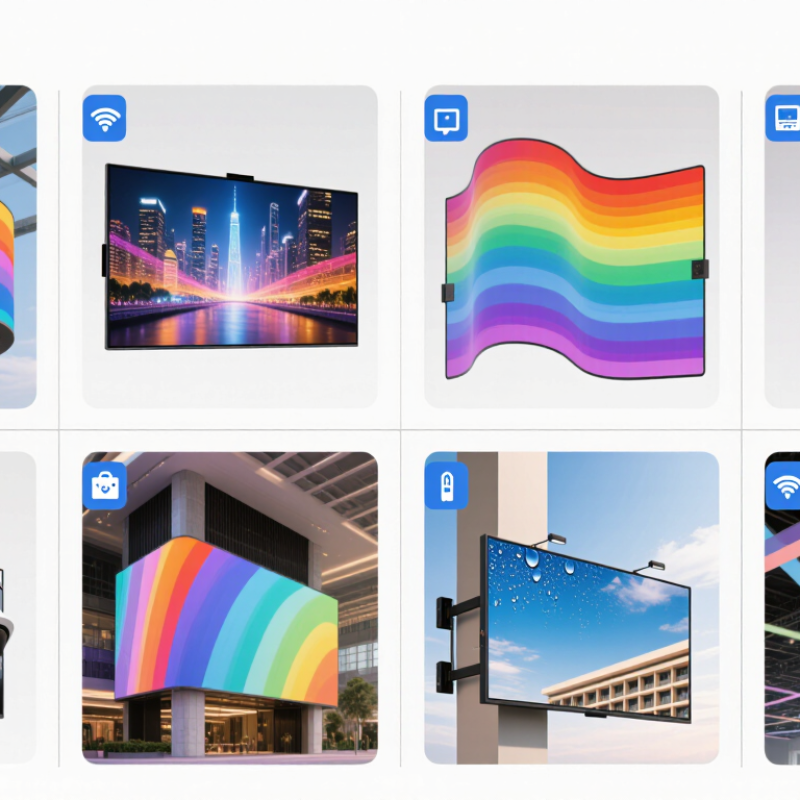
Common types include curved, cylindrical, ribbon, mesh, transparent, foldable, soft-panel, spherical, wave-shaped, and custom-shaped displays. Each type serves a different installation need. Curved displays suit rounded walls. Mesh versions reduce wind resistance outdoors. Transparent models preserve visibility through glass or open structures. Soft panels are useful for temporary stage designs and creative retail spaces.
Core characteristics include low weight, a small bending radius, modular construction, and easy maintenance access. Pixel pitch affects viewing distance and image detail. Brightness, refresh rate, contrast, and weather protection also matter. Installers should check the permitted bending direction carefully. Excessive folding can damage internal connections. That mistake is easy to make.
Flexible displays usually require a stable mounting surface, reliable power distribution, and precise module alignment. Heat management remains important, even when the screen feels soft. In practical projects, the most flexible option is not always the best option. A tighter curve may create visible image distortion. Engineers should test a sample section before approving the full installation. Surface shape, viewing distance, maintenance space, and local climate should guide the final choice.
Flexible LED displays are classified by structure and form, not only by pixel pitch.
The top 10 types include soft-module, bendable-strip, curved-concave, curved-convex, cylindrical, wave-shaped, foldable, rollable, mesh, and transparent displays.
Soft modules use flexible circuit boards and magnet-based cabinets. They suit columns, arches, and irregular walls. Bendable strips create narrow curves around retail counters or stage edges.
Concave and convex forms control the viewer’s angle and visual depth. Cylindrical displays wrap around pillars, while wave-shaped screens create moving architectural lines.
Foldable and rollable structures improve transport, but repeated handling may stress solder joints. Mesh designs reduce wind resistance on outdoor façades. Transparent forms preserve sightlines through glass, although daylight contrast remains a practical weakness.
A 2024 MarketsandMarkets report identifies flexible displays as a double-digit-growth segment through 2029, driven by signage, events, and transportation applications. Its classification also shows why “flexible” does not mean unlimited bending.
Tips:
Measure the tightest curve before selecting a module. Check the minimum bending radius, cabinet weight, refresh rate, and service access. In field installations, installers often focus on shape first and maintenance second. That is a costly mistake. Brightness figures also need context; laboratory values can differ from outdoor performance. A careful trial panel is still worthwhile, especially for wave-shaped or transparent structures.
Flexible LED displays are no longer limited to flat advertising walls. MarketsandMarkets reported that the global LED display market could grow from about USD 7.5 billion in 2023 to USD 11.8 billion by 2028. This growth reflects demand for lighter, curved, and quickly installed screens. However, “flexible” is not perfectly standardized. Some products bend slightly, while others genuinely roll around a narrow cylinder.
The ten major types include flexible mesh displays, LED curtains, soft LED panels, LED ribbons, foldable displays, rollable screens, transparent flexible displays, cylindrical displays, wearable LED displays, and creative 3D displays. Mesh models suit building façades because airflow reduces wind pressure. Curtain displays work well on stages, with lightweight strips moving during installation. Soft panels fit columns and irregular walls. LED ribbons create continuous curves around retail counters. Foldable and rollable types simplify transport, although repeated bending can shorten cable life.
Transparent flexible displays preserve views through glass storefronts. Cylindrical screens wrap around pillars and create uninterrupted images. Wearable displays support costumes, sports clothing, and interactive performances. Creative 3D screens use angled modules to produce depth effects, but they need careful viewing-distance planning. Grand View Research identifies fine-pitch LED development as a major display trend, especially where close viewing demands sharper images. In practical installations, pixel pitch, bending radius, heat control, and service access matter more than appearance alone. A beautiful prototype may still fail in dust, rain, or daily folding. That uncomfortable detail deserves testing.
Flexible LED displays serve different spaces, so installation should follow the structure, viewing distance, and maintenance needs.
Flexible LED mesh suits building facades and concert stages. Technicians usually attach it to tensioned steel cables, leaving airflow behind the screen. Soft LED modules fit retail columns and curved counters. They mount with magnetic frames or adhesive backing, but dusty surfaces can cause early failure. Curved LED panels create arches in museums and event halls. Adjustable brackets help form the radius without stressing the modules. Cylindrical displays work well around pillars. A circular support frame keeps pixel alignment consistent. It looks simple. It is not.
Transparent flexible LED screens suit storefront windows and glass partitions. Installers use slim clips, leaving enough clearance for cleaning and ventilation. Foldable LED screens support touring events and temporary exhibitions. Hinged frames allow quick setup, although repeated folding can loosen connectors. Flexible LED ribbons fit narrow signs, vehicle interiors, and cabinet edges. They usually sit inside aluminum channels for protection. Wearable LED panels serve costumes and interactive performances. Lightweight fabric mounts reduce movement, but battery weight needs careful balancing.
Flexible floor LED displays can support exhibitions and stage walkways when protected by a load-rated surface. Interlocking frames make replacement easier. Curved rental screens suit product launches and live broadcasts. Ground supports, ballast, and safety lanyards are essential. Finally, flexible poster displays work in retail windows and transport areas. A wall rail or weighted base allows fast relocation. Cable routing is often overlooked. Field measurements, load checks, ventilation tests, and module access should happen before installation, even when the project appears small.
| Flexible LED Display Type | Main Structure and Characteristics | Typical Pixel Pitch | Key Applications | Common Installation Method | Important Considerations |
|---|---|---|---|---|---|
| Flexible Soft-Module Display | LED modules mounted on flexible circuit boards with magnetic or sewn-in support systems; suitable for curved surfaces. | Indoor: 1.5–4 mmOutdoor: 4–10 mm | Curved advertising walls, stage backgrounds, exhibition booths, retail interiors, and architectural feature walls. | Attach modules to a curved steel frame, magnetic backing plate, hook-and-loop system, or custom-shaped support structure. | Requires accurate module alignment and adequate ventilation; the minimum bending radius must be observed. |
| Flexible LED Ribbon or Strip Display | Narrow, lightweight LED strips or segmented ribbon modules designed for linear or decorative visual effects. | Usually 10–50 mm | Edge lighting, signage outlines, scenic décor, retail shelving, event structures, and architectural contours. | Use adhesive backing, clips, aluminum channels, or mechanical fasteners on a clean and stable surface. | Best for accent graphics and low-resolution messaging rather than detailed full-screen video. |
| Flexible LED Curtain Display | LED bars, strings, or lightweight modules connected by flexible cables, creating a foldable curtain-like screen. | Typically 10–50 mm | Concert stages, touring events, temporary advertising, interior partitions, and decorative installations. | Suspend from a truss, ceiling rail, pipe grid, or lightweight frame using clamps, hooks, or safety cables. | Fast to deploy and transport; cable management and wind protection are essential for outdoor use. |
| Cylindrical LED Display | Flexible modules arranged around a circular or oval support to create continuous 360-degree or partial-radius viewing. | Usually 2.5–10 mm | Columns, atriums, museum exhibits, shopping centers, transportation spaces, and themed environments. | Wrap flexible modules around a prefabricated cylindrical frame, using magnets, brackets, straps, or a custom mounting shell. | Requires precise circumference calculations, service access, and careful control of vertical seams. |
| Concave and Convex Curved Display | Flexible LED panels shaped inward or outward to form smooth concave, convex, wave, or S-curve surfaces. | Commonly 2.5–6 mm | Immersive rooms, broadcast studios, retail displays, control-room features, and creative architectural façades. | Mount onto a curved steel or aluminum framework with adjustable brackets or magnetic module supports. | The frame radius must match the display specification; excessive bending can damage LEDs or circuit boards. |
| Flexible Mesh LED Display | Open-grid LED construction with a high proportion of transparent area, reduced weight, and improved airflow. | Typically 6–20 mm | Building façades, large windows, stadiums, bridges, event structures, and installations requiring airflow or visibility. | Hang from a top support beam, tension between perimeter frames, or secure with cables and lightweight mounting bars. | Offers lower wind load than solid panels, but image contrast depends strongly on background lighting. |
| Transparent Flexible LED Display | Flexible transparent strips, films, or grid assemblies that allow light and visual sightlines to pass through the screen. | Usually 8–25 mm | Glass façades, retail windows, museums, airports, showrooms, and media surfaces where transparency is required. | Apply to glass with approved mounting materials, suspend from a top rail, or attach to a transparent structural frame. | Needs careful brightness planning; reflections, direct sunlight, and glass heat gain can affect readability and reliability. |
| Foldable LED Display | Segmented or hinged LED construction that can be folded for transport and opened into a larger screen during use. | Commonly 2.5–10 mm | Mobile events, conferences, touring productions, temporary retail campaigns, and portable presentation systems. | Unfold on a level surface, connect locking sections, and secure with rear supports, hanging hardware, or a portable frame. | Protect hinges, cables, and module edges during folding; never exceed the specified fold angle. |
| Rollable LED Display | Lightweight LED panels or flexible pixel assemblies designed to roll around a drum or into a compact transport case. | Usually 2.5–10 mm | Portable presentations, temporary exhibitions, touring entertainment, pop-up stores, and compact digital signage. | Roll out onto a tensioned frame, rigid backing, floor stand, or wall-mounted support system before operation. | Requires controlled rolling speed, a defined storage diameter, and protection from creasing or point pressure. |
| Free-Form and Custom-Shaped LED Display | Individually designed flexible modules cut, arranged, or assembled into circles, waves, letters, logos, or irregular forms. | Often 2.5–10 mm | Art installations, themed entertainment, branded environments, sculpture displays, creative façades, and experiential spaces. | Create a digital template and custom support frame, then install modules with magnetic, adhesive, clip-on, or screw-fixed methods. | Requires custom signal mapping, detailed structural planning, and accessible service zones for maintenance. |
Flexible LED displays come in many forms: soft modules, LED mesh, ribbon screens, curved panels, cylindrical screens, spherical screens, foldable screens, transparent flexible screens, corner displays, and custom-shaped installations. Choosing among them depends on the space, viewing distance, and required movement. A ribbon screen suits narrow columns, while soft modules handle artistic curves and uneven surfaces. Mesh displays reduce weight, which helps with large suspended structures.
Check the pixel pitch before purchasing. Smaller pitches show sharper images at close range, but they usually cost more. Measure the nearest viewing position, not only the room size. Brightness also matters. Indoor displays may need gentle brightness, while outdoor screens require stronger output and weather protection. Confirm the module’s bend direction and minimum bending radius. Forcing a panel beyond its limit can create dead pixels or uneven brightness. Maintenance access is often overlooked. A beautiful curved screen becomes inconvenient when technicians cannot reach the rear.
Tips: Request real samples, not only digital drawings. Test the screen under your actual lighting. Ask about refresh rate, power use, spare modules, and control compatibility. Check installation weight carefully. A perfect screen rarely exists. I would prioritize safe mounting and easy servicing over an impressive shape. Some custom designs look excellent in photographs but perform poorly from side angles. A short trial installation can reveal that problem early.
The chart compares representative pixel pitches commonly used across major flexible LED display formats. Smaller pixel pitches are generally better for close viewing, while larger pitches are often selected for outdoor, architectural, or long-distance applications.
How to choose: Select the display type according to viewing distance, installation shape, indoor or outdoor conditions, brightness requirements, bend radius, maintenance access, and expected content. For close-up indoor viewing, consider fine-pitch soft modules or curved rental panels. For façades and large structures, LED mesh, curtain, transparent, and cylindrical formats can reduce weight and improve flexibility.
It is an electronic screen built with bendable circuit boards and lightweight modules. It follows curved walls, columns, stages, vehicles, and unusual surfaces. The LED chips themselves do not create the flexibility.
Common forms include soft-panel, ribbon, curved, cylindrical, mesh, transparent, foldable, rollable, wave-shaped, and custom-shaped displays. Each type fits a different installation condition. A ribbon display suits narrow columns. A mesh display reduces wind resistance.
Cylindrical displays wrap around pillars and rounded structures. Wave-shaped screens create flowing architectural lines. They can make a space feel more dynamic. Side-angle testing remains important.
Measure the surface shape, viewing distance, nearest viewer, and available maintenance space. Choose soft modules for uneven curves and artistic surfaces. Select mesh structures for lightweight outdoor installations. The most flexible option is not always the most suitable.
Pixel pitch affects image detail and viewing distance. Smaller pitches usually look sharper from nearby positions. They may also increase cost and power needs. Measure the nearest viewing point, not only the room size.
Check the permitted bending direction and minimum bending radius. Forcing a panel beyond its limit can damage internal connections. It may cause dead pixels or uneven brightness. That mistake is easy to make.
Indoor screens may need moderate brightness for comfortable viewing. Outdoor displays require stronger output and suitable weather protection. Laboratory brightness figures may differ from outdoor performance. Real lighting tests are better.
Request a physical sample or trial panel. Test it under actual lighting and from different viewing angles. Check refresh rate, power use, mounting weight, and image distortion. A short trial can expose problems early.
Provide clear service access behind or around the screen. Use modular construction and keep spare modules available. Check power distribution and heat management carefully. A beautiful curved screen becomes frustrating when technicians cannot reach it. No screen is perfect.
Flexible LED displays are lightweight, bendable visual solutions designed to fit curved, irregular, or creative surfaces while maintaining bright, high-resolution image performance. Their core characteristics include flexibility, low weight, modular construction, easy transport, and adaptable installation. They can be classified by structure and form, including soft modules, flexible panels, curved displays, cylindrical screens, ribbon-style displays, mesh screens, foldable units, wearable screens, transparent flexible displays, and creative shape-based installations.
Each type serves different purposes, from stage backdrops and retail decoration to architectural media façades, exhibitions, events, and immersive environments. Installation methods may involve magnetic attachment, frames, hanging systems, adhesive support, or custom structural mounting. Choosing the right Flexible LED displays requires evaluating the required curvature, screen size, pixel pitch, brightness, viewing distance, indoor or outdoor conditions, maintenance access, power consumption, and budget. A clear understanding of the installation space and content requirements helps ensure reliable performance, visual impact, and long-term practicality.