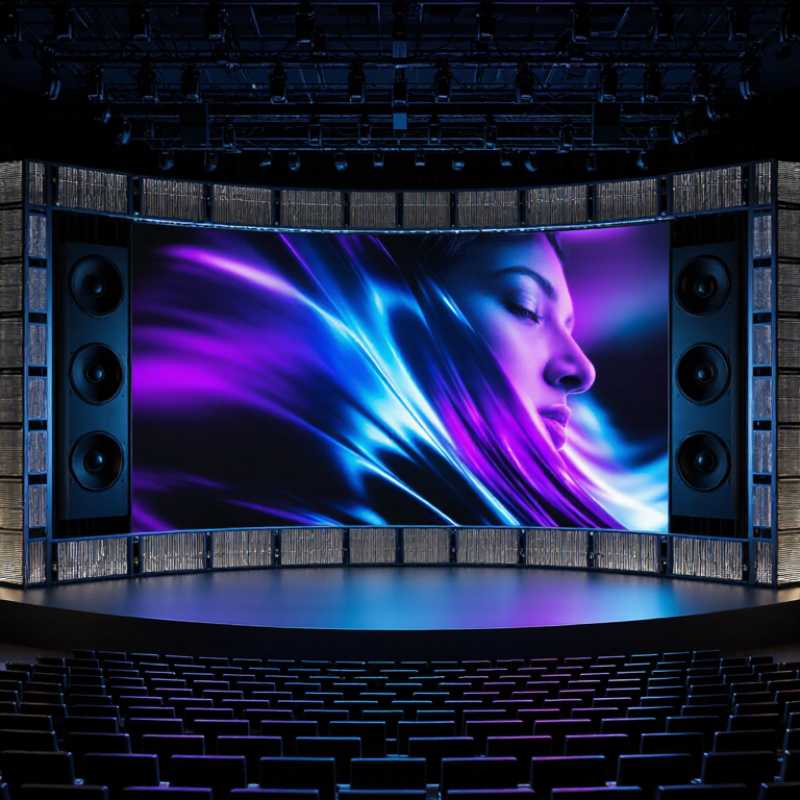
Acoustically transparent LED screens are changing how venues combine large-scale images with clear, natural sound. They allow speakers to sit behind the display, reducing visual clutter while preserving the audience’s sightline. This design matters in theaters, broadcast studios, houses of worship, museums, and immersive entertainment spaces.
John Meyer, founder of Meyer Sound and a respected professional in audio system design, once expressed a useful principle: “The best sound system is the one you don’t hear.” Acoustically transparent LED screens apply that idea visually. The image commands attention, while voices, music, and effects appear to come from the screen itself. It feels convincing when alignment, pixel pitch, brightness, and speaker placement work together.
Still, transparency is not magic. LED modules can reflect sound, create high-frequency loss, or restrict installation depth. Engineers must measure airflow, acoustic attenuation, viewing distance, and room reverberation before choosing a product. A screen that performs well in a television studio may disappoint in a concert hall. That difference is easy to overlook.
This guide examines the top types of Acoustically transparent LED screens, including perforated, mesh, flexible, and fine-pitch solutions. Each type offers a different balance between image quality, sound transmission, structure, and maintenance. Real projects also reveal uncomfortable compromises. Higher transparency may reduce contrast. Smaller pixels may increase cost. Better results usually come from careful testing, not impressive specifications alone.
Top Types of Acoustically Transparent LED Screens
What Acoustically Transparent LED Screens Are
Acoustically transparent LED screens allow sound to pass through their display surface. They usually use perforated modules, open-grid structures, or narrow LED bars. These designs leave controlled gaps between pixels. Speakers can sit behind the screen, preserving both visual impact and direct audio delivery.
The term can be misleading. A transparent LED panel is not automatically acoustically transparent. Its frame, wiring, coating, and pixel density may still reflect or block sound. Perforated LED modules normally provide better airflow and sound passage, but they can reduce image uniformity. According to MarketsandMarkets’ 2024 LED Display Market report, the wider LED display market is projected to grow from about USD 7.4 billion in 2023 to USD 11.7 billion by 2028. This growth increases demand for integrated visual and acoustic installations, although the report does not measure acoustic performance specifically.
Tips: Request frequency-response and transmission-loss measurements, not only transparency percentages. ISO 354 and ASTM C423 address sound absorption, while ASTM E90 evaluates airborne sound transmission loss. Ask for tests across speech and music frequencies. A screen may look open yet sound dull behind it. This is where specifications can disappoint. Check speaker alignment, ventilation, brightness, and viewing distance together. In real venues, a small pixel gap can affect detail, while excessive openness may weaken image quality. Calibration remains necessary.
Typical open-area ratios show how much of the screen structure remains available for sound to pass through.
LED mesh and grille-style systems generally provide the strongest acoustic transparency because their open structures allow sound waves to pass through with less obstruction. Perforated LED panels can also support sound transmission, but their performance depends on hole size, spacing, cabinet depth, and the amount of LED hardware in the sound path. The values shown are representative open-area ranges used for design comparison rather than brand-specific specifications.
Acoustically transparent LED screens transmit sound through open spaces between LED bars. The diodes create images, while the gaps preserve the sound path. Their performance depends on pixel pitch, cabinet structure, and open-area ratio. Industry display surveys often report transparency between 60% and 90%. However, this range is not an acoustic guarantee. A dense screen can still reduce high-frequency clarity. That can affect speech, cymbals, and audience direction.
ISO 10140-2 measures airborne sound insulation across frequency bands in laboratory conditions. Designers should use similar frequency-based testing before approving a screen for theaters or live venues. The World Health Organization’s Environmental Noise Guidelines for the European Region also stresses frequency, duration, and listener position. In practice, installers should compare sound-pressure levels with the screen powered on and off. A small change may matter. The first layout is rarely perfect.
Tips: Keep loudspeakers outside the LED plane whenever possible. Align screen gaps with the main sound path. Test speech intelligibility from several seats, not only the control desk. Measure both 125 Hz bass response and higher vocal frequencies. Do not trust transparency percentages alone. They describe visibility more reliably than sound transmission.
Acoustically transparent LED screens allow sound to pass through the display surface. The most common type is the LED mesh screen. Its open structure uses narrow bars, leaving regular gaps between pixels. This design works well in concert halls, theaters, and outdoor stages. Speakers can remain behind the screen without severe sound blockage. It also reduces wind pressure on large installations.
Perforated LED panels form another important category. Small holes are arranged across a rigid panel, creating a balance between image quality and sound transmission. These screens often provide better surface stability and a cleaner appearance than open mesh. However, the holes can slightly affect brightness, contrast, and viewing angles. Careful testing is necessary. Room acoustics still matter.
Fine-pitch open-frame LED screens offer sharper images at closer viewing distances. They use exposed modules or spaced cabinet structures to preserve airflow and sound movement. This option suits broadcast sets, immersive exhibitions, and indoor performance spaces. In practical venue testing, speaker placement changed the final result more than expected. A screen may be acoustically open but still create reflections or uneven volume. No type is perfect. Installers should measure sound response, viewing distance, brightness, and maintenance access before choosing a structure. A visually impressive screen can still perform poorly if these details are ignored.
Acoustically transparent LED screens are not one uniform product. Their performance depends on pixel structure, open area, cabinet depth, and installation distance. LED mesh screens use open strips or bars, allowing sound and air to pass around the display. They are lightweight and useful for large stages, but their wider pixel pitch can reduce close-viewing clarity. Perforated LED cabinets provide denser images through carefully placed openings. However, smaller openings may cause measurable high-frequency loss, especially when the screen sits directly in front of speakers. Fine-pitch transparent panels create sharper images at short distances. They usually demand tighter manufacturing tolerances and more careful heat management.
Brightness is a major difference. Outdoor transparent screens need strong light output, while indoor versions can use lower brightness for natural skin tones. Contrast also changes with the background. A dark stage improves perceived black levels; daylight can wash them out. Refresh rate matters for camera work. A high refresh rate and stable grayscale reduce scan lines and color stepping during filming. Installers should test the screen with the actual loudspeakers, not rely only on specifications. Measure sound pressure behind and in front of the display across several frequencies. This reveals losses that a simple acoustically transparent label may hide.
Ventilation, service access, and weight affect reliability over time. I have found that a slightly less dense panel can perform better when speech clarity matters more than image detail. That choice feels imperfect. Yet it often serves the audience better. Leave enough space for speaker aiming and cable maintenance. Small installation errors can change both sound coverage and visual uniformity.
| Screen Type | Typical Acoustic Openness | Typical Transparency | Typical Brightness | Typical Weight | Common Pixel Pitch | Main Performance Strength | Key Limitation | Best-Fit Applications |
|---|---|---|---|---|---|---|---|---|
| LED Mesh Screen | Approximately 50–80% open area | Approximately 20–60%, depending on louver spacing and viewing angle | About 4,000–8,000 nits | About 10–18 kg/m² | Approx. 10–30 mm | High airflow, low wind load, and strong outdoor visibility | Lower image detail than fine-pitch LED products; visible structure at close range | Building façades, outdoor stages, retail windows, and large architectural displays |
| LED Curtain Screen | Approximately 60–90% open area | Approximately 30–70% | About 4,000–7,000 nits | About 6–12 kg/m² | Approx. 15–50 mm | Very light, flexible, quick to install, and highly permeable to sound and air | Coarser resolution and less uniform close-up appearance | Concert stages, touring productions, event backdrops, and temporary installations |
| Transparent LED Film | Usually limited; depends on film coverage and glass gaps | Approximately 70–95% when viewed through unused areas | About 1,000–5,000 nits | About 5–10 kg/m², excluding the supporting glass | Approx. 3–10 mm | High visual transparency, thin construction, and good close-range image quality | The glass surface can reflect or block sound; heat management and adhesion require careful design | Retail storefronts, museums, airports, offices, and interior glass partitions |
| Transparent LED Glass | Low to moderate; commonly requires acoustic treatment around the panel system | Approximately 60–90% | About 2,000–6,000 nits | About 25–45 kg/m², depending on glass thickness and framing | Approx. 3–10 mm | Rigid, premium appearance with strong optical clarity and architectural integration | High structural load, installation complexity, and weaker natural sound transmission | Permanent façades, showrooms, corporate lobbies, and high-end architectural glazing |
| Fine-Pitch Transparent Mesh | Approximately 40–70% open area | Approximately 20–50% | About 2,500–6,000 nits | About 12–25 kg/m² | Approx. 4–10 mm | Improved image detail while retaining meaningful airflow and acoustic permeability | Higher power, weight, and cost than coarse-pitch mesh or curtain systems | Broadcast stages, indoor venues, premium retail, and installations viewed from shorter distances |
Note: The figures shown are typical industry ranges rather than guaranteed specifications. Actual acoustic openness, transparency, brightness, weight, power consumption, and weather resistance vary with pixel pitch, LED package, cabinet design, viewing distance, mounting method, and installation environment.
Choosing the right screen starts with the installation setting, not the pixel pitch. In theaters and concert venues, fine-mesh LED screens usually work best behind performers. Their open structure lets microphones, speakers, and stage monitors operate with less blockage. Sound still matters. A dense cabinet may look impressive but create unwanted reflections or coverage gaps.
For retail windows, transparent LED panels can preserve daylight and storefront visibility. However, optical transparency does not always guarantee strong acoustic performance. Check the panel’s open-area ratio, brightness, viewing angle, and ventilation needs. In a busy shopping street, higher brightness may be necessary. Indoor displays usually need less output and quieter cooling. Measure twice.
Outdoor façades and stadium installations require weather-resistant mesh screens with secure mounting systems. Wind load, rain protection, service access, and viewing distance should guide the specification. A screen designed for a lobby may fail on a tall exterior wall. I have seen projects focus heavily on image quality and overlook speaker placement. That mistake can weaken the whole experience. No screen is perfect, so test a sample with real audio, lighting, and audience distance before approving the final layout.
It displays images while allowing sound to pass through open spaces. Speakers can sit behind the display surface.
No. Frames, wiring, coatings, and dense pixels may block or reflect sound.
Sound travels through gaps between LED bars, perforated modules, or open-grid structures. The openings preserve the audio path.
No. Transparency usually describes visibility, not acoustic performance. A screen may look open but reduce high-frequency clarity.
Speech, cymbals, and directional cues may lose clarity. High frequencies are often affected first.
Request frequency-response and transmission-loss measurements. Test speech and music frequencies, not only visual transparency.
Compare sound levels with the screen powered on and off. Test speech from several audience seats, including side positions.
Keep loudspeakers outside the LED plane when possible. Align screen gaps with the main sound path.
Pixel pitch, cabinet structure, open-area ratio, brightness, ventilation, and viewing distance all matter.
Not always. The first layout may be wrong. Recheck speaker alignment, bass response, and speech intelligibility after calibration.
Acoustically transparent LED screens are display systems designed to deliver vivid, high-resolution visuals while allowing sound to pass through the screen surface. Their structure typically combines carefully spaced LED modules, open areas, and specialized mounting designs that reduce obstruction to speakers positioned behind or near the display. This makes them suitable for environments where visual communication and clear audio must work together.
The main types include mesh-style screens, perforated panel screens, transparent modular displays, and lightweight flexible configurations. They differ in pixel pitch, transparency, brightness, viewing angle, sound permeability, weight, durability, and installation complexity. When choosing a screen, it is important to consider the venue’s size, ambient lighting, viewing distance, speaker placement, structural limitations, and maintenance requirements. Indoor installations may prioritize fine image detail and low weight, while outdoor or large-scale settings often require higher brightness, stronger protection, and greater weather resistance. A balanced selection ensures reliable performance without compromising either visual quality or audio clarity.