Center-hung arena LED displays are large video screens suspended above the center of an indoor venue. They give spectators a clear view from seats across the arena, whether the screen shows live action, replays, scores, or sponsor content. The display often hangs as a multi-sided structure, with its height and footprint shaped by sightlines, roof capacity, and the venue’s layout.
A useful way to describe the design challenge is through this illustrative expert perspective from arena-display specialist Maya Chen: “A screen is only successful when the farthest seat can follow the action without losing the view of the court.” This is an original illustrative quote, not a verified statement from a real industry expert. In practice, planning also involves pixel pitch, brightness, viewing angles, service access, and integration with audio and control systems. Details matter. A visible seam, glare on a polished floor, or blocked sightline can affect the experience. The structure must also be carefully engineered for its venue; a design that works in one arena may not suit another. This guide explains what a center-hung display is, how its main components work, and what venues should consider before choosing one. The right solution is not always the biggest screen. It is the one that fits the building and serves its audience.
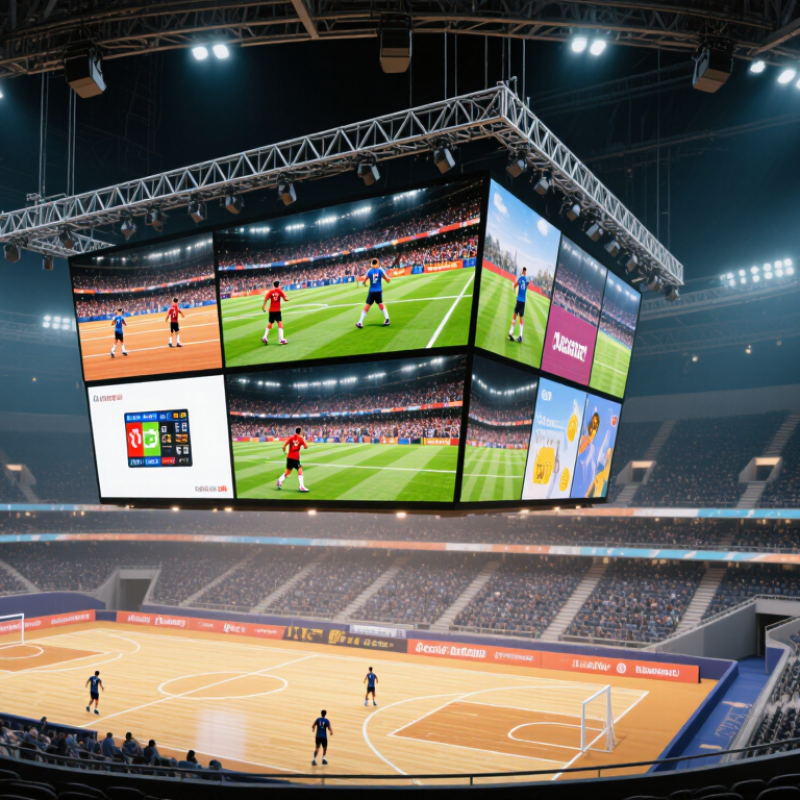
A center-hung arena LED display is a suspended video system positioned above the playing surface, often near center court or ice. Unlike a single end-wall screen, it uses multiple faces to reach spectators around the seating bowl. Its core functions include showing scores and clocks, replaying key moments, and displaying live graphics. Some designs add a circular ribbon or separate corner screens. Those are optional.
The structure is usually a four-sided cube, rectangle, or ring. Designers balance pixel pitch, brightness, viewing angles, refresh rate, and safe rigging. The right balance depends on seating distance and ambient light; bigger is not always clearer. Steel supports, accessible service panels, and reliable signal paths matter because repairs above a crowded floor are difficult. Grand View Research’s 2024 LED Display Market report valued the global market at USD 7.1 billion in 2023 and forecast an 8.4% compound annual growth rate through 2030. That broad market figure signals wider investment, but it does not prove that every arena needs a larger screen. A practical design can still get this wrong: bright graphics may compete with the action, and small text disappears from distant seats.
| Dimension | Definition or Typical Characteristics | Practical Consideration |
|---|---|---|
| Definition | A large-format LED display assembly suspended from the arena roof structure, typically above the central playing area. | It presents live video, scores, statistics, replays, and event information to spectators around the venue. |
| Display configuration | Common designs use four main viewing faces; some installations add angled corners, ribbon displays, or other sections. | The number and orientation of faces are selected to suit the seating bowl and sightlines. |
| Mounting and position | The display is supported by a purpose-designed suspension and rigging system and positioned near the arena’s center. | Structural capacity, safe access, cable routing, and clearance from lighting or other equipment must be assessed during design. |
| Screen dimensions | There is no single standard size. Overall dimensions depend on venue scale, ceiling height, viewing distance, and event requirements. | The display should be sized so that content remains legible from the intended seating areas without obstructing views. |
| LED pixel pitch | Pixel pitch is the distance between adjacent LED pixels, measured in millimeters. Indoor arena displays may use pitches in the several-millimeter range. | A smaller pitch can provide finer detail at close viewing distances, while the appropriate choice depends on budget, screen size, and typical audience distance. |
| Brightness | LED panels produce their own light, and brightness can usually be adjusted to match the venue and content. | Settings should account for ambient lighting, camera exposure, spectator comfort, and applicable venue requirements. |
| Refresh and camera use | Refresh rate and image-processing performance affect how the display appears on camera, especially during live broadcasts. | Compatibility should be checked with the venue’s cameras and production equipment; specifications vary by system. |
| Content and control | Content is commonly managed through a control system that can combine video, graphics, scores, and scheduled messages. | Multiple faces can show the same content or different layouts, depending on the control setup and event needs. |
| Viewing coverage | The elevated, central placement is intended to make key information visible from many parts of the seating bowl. | Final face angles and display height should be planned around seating geometry and potential sightline obstructions. |
| Maintenance and access | LED displays consist of serviceable modules and supporting electronics; access methods depend on the installation design. | Maintenance planning should address safe access, replacement parts, ventilation, power, and the time needed for repairs. |
| Primary benefit | Combines prominent event information and visual content in one central installation, helping create a shared viewing focus. | Its usefulness depends on clear content design, reliable operation, and good visibility from the venue’s seats. |
Note: Specifications and configurations vary by venue and project. The characteristics above are general design considerations, not universal standards.
Display cabinets attach to a steel frame connected to engineered roof lifting points. Hoists or fixed rigging hold the assembly, while safety cables provide extra restraint. Not just the screen.
They should verify roof capacity, total weight, uneven loading, lifting movement, and attachment points. Cable routes and maintenance access need an on-site review. Drawings can miss a real hatch.
Sports layouts can show scores, replays, and player details. Concerts may use live camera shots and bold visuals; graduations can display names and ceremony cues. One layout rarely fits all.
Test text and graphics from actual seats, including the upper deck. Adjust brightness and motion for each event. Less may work better.
Plan power, data, cooling, rigging, and service access together. Separate power and signal routes where practical, and label connectors before lifting. Labels save time.
Test every panel, backup signal path, brightness setting, and emergency shutdown procedure. Record operating temperatures and power draw as a baseline. Do not assume.
Use brightness presets for daylight, camera conditions, and event content. Avoid maximum output by default; processors and cooling also consume energy. LED alone is no guarantee.
Schedule inspections around the event calendar. Check fans, filters, connectors, panel alignment, and dust near restricted airflow. Keep fault logs and replacement-module records. A clean image can mislead.
Center-hung arena LED displays are large digital screens suspended above the center of an arena, where they can be seen from seats throughout the venue. Typically built as a multi-sided structure, the display combines LED panels with a supporting frame, rigging, power systems, and control equipment. Its height and position are planned to provide clear sightlines while fitting the arena’s layout and safety requirements.
During events, the screens can show live action, replays, scores, schedules, announcements, and other visual content. They are commonly used in sports arenas, concert venues, and multipurpose entertainment spaces to keep audiences informed and engaged. Successful installation and operation depend on factors such as structural capacity, viewing angles, screen size, ventilation, electrical access, and reliable content control. Regular inspections, cleaning, and maintenance help preserve image quality and support dependable performance over time.