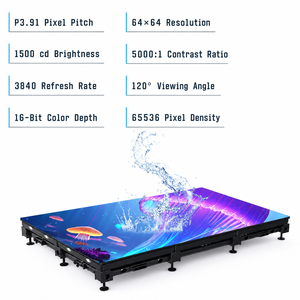
Engineered for zero-flicker broadcast recording, camera shutter compatibility, and rugged rental execution. Certified by CE, RoHS, FCC, and ETL with strict factory-floor FAT.
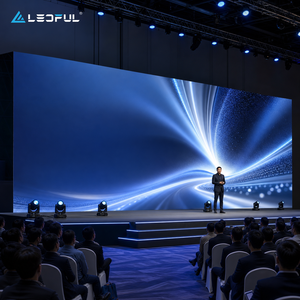

Why modern broadcast studios, corporate auditoriums, and virtual production sets cannot compromise on Pulse-Width Modulation (PWM) frequency and grayscale precision.
| Evaluation Parameter | Standard Refresh (1,920Hz) | High Refresh (3,840Hz) | Ultra Broadcast/xR (7,680Hz+) |
|---|---|---|---|
| PWM Driver Architecture | Basic Constant Current Driver (Shift Register) | Dual-Latch High-Scan PWM IC (e.g., MBI5153 / ICN2153) | Dynamic GCLK Embedded High-Speed PWM (e.g., MBI5264 / Chipone) |
| Camera Shutter Sync (1/1000s) | Severe Black Scanning Bars visible on camera | Clean capture under standard 1/250s shutter | Zero visual artifacts at up to 1/2000s high-speed shutter |
| Grayscale at Low Brightness | Severe color cast, non-linear stepping below 20% | 14-bit smoothed gradation down to 10% brightness | Full 16-bit to 22-bit linear gamma retention down to 1% |
| Ghosting & Open Detection | External pull-up resistors required, ghost traces | Integrated active circuit anti-ghosting | Automated per-pixel open/short suppression & caterpillar elimination |
| Thermal Footprint & Efficiency | Traditional Common Anode (High Heat Loss) | Optimized Anode / Hybrid Power Routing | Pure Common Cathode (Cold Screen, -35% Power Draw) |
Visual refresh rate is mathematically dictated by the Gray Clock (GCLK) frequency and driver IC scan ratio. When engineering systems for live stadiums and broadcast stages, our China manufacturing facilities implement dedicated high-frequency oscillator lines, decoupling internal PWM timing from external frame synchronization to assure uninterrupted 7680Hz scanning even when receiving native 120Hz or 240Hz frame signals.
For fine pitch indoor panels (P1.25 to P2.5) installed on TV broadcast sets and conference halls, pixel pitch resonance with camera sensors creates high-contrast moiré interference. Our manufacturing protocol integrates optical micro-matte resin masks and surface diffusion treatments, attenuating geometric phase patterns while maintaining a 98% pure optical output efficiency.
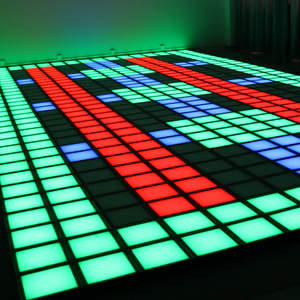
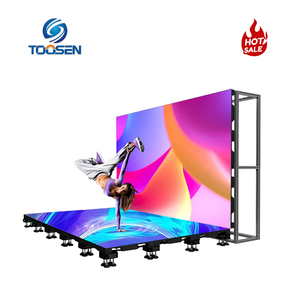
In interactive floor applications, such as our "Active Floor is Lava" game tiles and gravity-sensing stage modules, input-to-display latency is constrained to under 10ms. Real-time pressure sensors interface through high-speed RS-485 and gigabit Ethernet controllers directly with the display controller FPGA, mapping coordinates in microsecond intervals without frame tearing.
We solve the fundamental dilemma of international LED display procurement: eliminating quality variances, component swapping, and post-installation abandonment.
Unlike trading entities that pass boxes through wholesale channels, our senior AV engineers are permanently stationed on the factory production line in Shenzhen. Every batch undergoes rigorous 72-hour continuous thermal burn-in, spectroradiometer color uniformity scanning, and comprehensive Factory Acceptance Testing (FAT) with signed verification certificates before freight clearance.
Through our UK-engineered and internationally patented digiLED ZEUS® intelligent power management tool, our high-refresh panels eliminate standby parasitic load completely. Large-scale installations—including sports stadium fascia ribbons and 300sqm outdoor arena displays—safely power down to zero watts during off-peak hours, dramatically dropping your venue's lifecycle carbon footprint.
Procuring from China is no longer a logistical risk. We back every international export with regional Pixel Depots across North America (Las Vegas), the United Kingdom, and Asia-Pacific. We store identical wafer batch spare modules, receiving cards, power supplies, and specialized surface-mount ICs for 5+ years post-commissioning to guarantee uncompromised color-matching longevity.
Viewing distances, pixel pitch selection, lux calculation, and mechanical structural analysis.
PCB routing optimization, Macroblock/Chipone IC pairing, and CNC die-cast frame milling.
Resident engineers execute 72h aging, optical white balance calibration, and vibration tests.
Shockproof flight casing, custom logistics documentation, customs clearance, and DDP delivery.
Pixel Depot spare parts inventory, factory calibration reload, and 24/7 technical helpdesk.
Anticipate architectural market shifts before finalizing capital expenditure across public venues, DOOH networks, and high-end rental assets.
Surface-mount device (SMD) architecture is rapidly yielding to Chip-on-Board (COB) and Micro-in-Package (MIP) encapsulation for sub-1.8mm pitches. Because flip-chip COB bonds micro-diodes directly to the PCB substrate without wire bonding, thermal dissipation is improved by 40%. Buyers are demanding Common Cathode architecture where Red, Green, and Blue diodes receive independent operational voltages (2.8V for Red, 3.8V for Blue/Green), eradicating wasted energy dropped across resistor networks.
Film studios and corporate broadcast venues are elevating refresh specifications from 3840Hz to 7680Hz and beyond, with frame rates progressing to 240Hz. Genlock phase-alignment against camera cinema shutters (ARRI, RED, Sony Venice) is now mandatory. Procurement teams must specify FPGA controllers featuring frame multiplexing, low-scan rates (1/8 scan or 1/16 scan max), and sub-frame color bit depth extension to avoid clipping in extreme highlights and deep shadows.
European and American commercial tenders now incorporate strict environmental footprint criteria (EU ErP Lot 9, Energy Star, RoHS-II compliance). Procurement decisions are no longer determined merely by initial purchase price per square meter. A screen drawing 850W/m² with standard idle draw incurs more than double the five-year operational cost of a precision engineered panel drawing 240W/m² average with intelligent zero-power standby capabilities.
Essential guidance for commercial integrators, production staging companies, and AV procurement committees.
Consult with our international AV engineering team for turnkey viewing distance analysis, detailed bill of materials (BOM), custom optical cabinet drawings, and competitive direct factory export quotes.