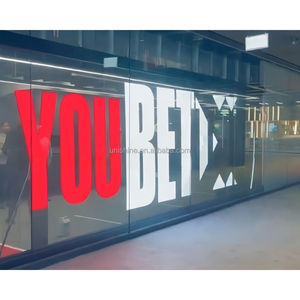
Transparent Led Film Screen Holographic 3D Advertising Window Glass Adhesive Super Slim
Holographic Film
Inquire Now

Engineered to operate seamlessly with state-of-the-art Chinese FPGA processing controllers, our flagship visual solutions provide unmatched refresh rates, wide color gamut accuracy, and rock-solid broadcast synchronization.
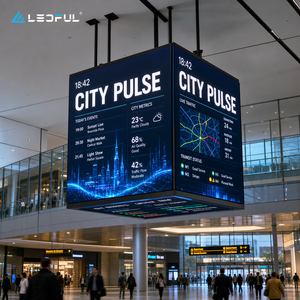
In modern commercial audiovisual deployments, the display canvas is only as competent as the video processing pipeline feeding it. Global AV consultants, broadcast directors, and system integrators sourcing from top China LED video processor exporters demand far more than standard scale-and-switch hardware. Mission-critical environments—such as utility grid command hubs, virtual production studios, high-profile esports arenas, and multi-sided landmark installations like our Suspended Four-Sided LED Cube—require uncompressed high-bandwidth video processing, hardware-level Genlock synchronicity, sub-frame processing latency, and precision chromatic uniformity across non-standard pixel dimensions.
Historically, commercial video walls relied on fragmented hardware chains comprising off-the-shelf scalers, external matrix switchers, and asynchronous sending cards. This legacy topology inevitably introduced clock jitter, frame drops, uneven tear lines across cabinet seams, and cumulative latency exceeding 3 to 5 frames. Today, the leading tier of Chinese video processor engineering focuses on dedicated FPGA (Field-Programmable Gate Array) matrices combined with high-speed serial transceiver backplanes. By bypassing general-purpose operating systems, these advanced processors ensure pure hardware pipeline computing, deterministic real-time video scaling, and instant failover redundancy.
When selecting a premier exporter in China, technical procurement teams must scrutinize the core processing engine. While GPU-based software servers handle complex generative media servers effectively, they carry nondeterministic operating system overhead that exposes large installations to buffer underruns, operating system crashes, and jitter. In contrast, industrial-grade FPGA processors utilize custom HDL (Hardware Description Language) code executing parallelized color transforms, motion-adaptive de-interlacing, and bicubic image interpolation on a dedicated clock cycle.
| Engineering Metric | Standard Commercial Media Converters | Tier-1 China FPGA Hardware Processors | Enterprise Broadcast / Virtual Production |
|---|---|---|---|
| Pipeline Processing Latency | 3 to 6 Frames (50ms - 100ms) | 1 Frame (16.6ms) or Sub-Frame | Ultra-low ≤ 0.5 Frame (< 8ms with Genlock) |
| Color Processing Bit Depth | 8-bit / 10-bit internal depth | 12-bit / 16-bit processing engine | Up to 22-bit grayscale mapping / HDR10 / HLG |
| Splicing Synchronization | Software frame buffer match | Hardware Genlock ± 5ns clock sync | Bi-level / Tri-level frame lock / Phase offset |
| Bandwidth Interface Support | HDMI 1.4 / Single DVI (1080p limit) | HDMI 2.0 / DP 1.2 / 12G-SDI / 10G Optical | DP 1.4 / HDMI 2.1 / SMPTE ST 2110 IP video |
| Hardware Redundancy | None (single power, single link) | Dual power supplies, hot backup loop | Full N+1 modular card redundancy & optical backup |
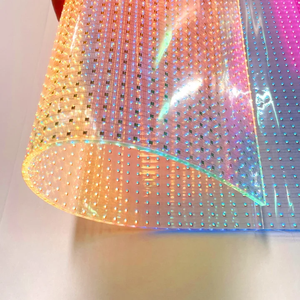
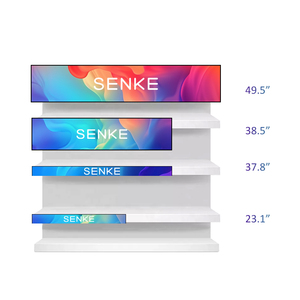
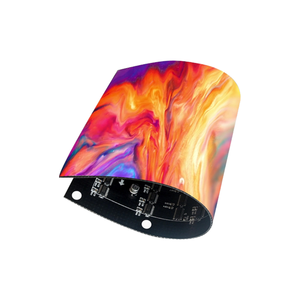
One of the hallmark competitive advantages of sourcing through top China exporters is the ability to map atypical display topologies without external warping boxes. Modern architecture frequently integrates specialized forms, such as our Indoor P1.2-P1.8 Micro LED COB Walls, ultra-thin Transparent Flexible Window Displays, or elongated Shelf Edge Stretched LCD Bars. Standard 16:9 processors cannot output native pixel-for-pixel timing to these custom geometries without stretching or letterboxing.
Advanced Chinese export-grade controllers feature fully customizable EDID (Extended Display Identification Data) management and arbitrary canvas layout engines. Each output channel can be freely rotated, cropped, overlapping-blended, and offset-aligned at the pixel level. This ensures that ultra-fine-pitch installations maintain true 1:1 pixel fidelity directly from the media server rendering node to every single LED diode, eliminating scaling blur, moiré degradation, and aliasing artifacts.
Critical for live broadcast, sports scoreboards, and virtual production where audio-to-video lipsync discrepancies or camera tracking phase mismatches destroy viewer immersion.
Simultaneous processing of up to 16 independent 4K inputs across large canvas zones with cross-fading, seamless cuts, and alpha-channel keying without dropping frames.
Dual redundant hot-swappable power modules, active-passive controller clustering, and optical link fallback protecting high-stakes public venue operations.
The global AV market is experiencing a profound technological transformation. For system integrators and procurement executives, anticipating hardware convergence is essential to preventing premature infrastructure obsolescence. As display manufacturing costs drop and pixel pitches push sub-millimeter boundaries, the technical burden shifts heavily toward video processing capabilities.
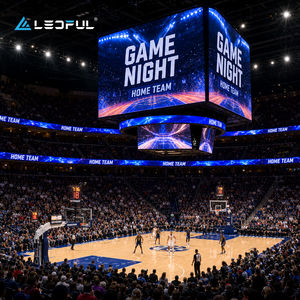
Traditional multi-cable DVI and HDMI matrix switches are rapidly yielding to distributed IP-based video backbones. Premier Chinese exporters are aggressively rolling out processor backplanes equipped with 10G/25G SFP28 optical interfaces capable of decoding uncompressed SMPTE ST 2110-20 (video), ST 2110-30 (audio), and ST 2110-40 (metadata) streams directly inside the LED sending unit. This eliminates hundreds of meters of bulky copper wiring and proprietary matrix crossbars, allowing any IP source across a campus LAN to be dynamically routed to high-resolution stadium displays like our P6 Stadium Advertising Facades with microsecond-level PTP (Precision Time Protocol) synchronization.
As COB (Chip-on-Board) and Micro LED technologies become the de facto standard for indoor enterprise boardrooms and command centers, traditional 8-bit processing results in visible color banding, particularly in dark regions. Advanced processors are now engineered with 22-bit internal color engines and dynamic contrast enhancement algorithms that match the high optical absorption and deep blacks of COB surfaces. Sourcing decisions over the next five years will prioritize processors featuring integrated 3D LUT (Look-Up Table) color management for full Rec.709, DCI-P3, and Rec.2020 color volume alignment.
Legacy scalers rely on standard bilinear or bicubic math, which softens high-frequency image details when upscaling 1080p surveillance or camera feeds to massive 8K display walls. Next-generation Chinese video processors are embedding neural processing units (NPUs) into FPGA logic blocks. These algorithms execute real-time edge sharpening, temporal noise reduction, and intelligent contrast mapping, ensuring that legacy video inputs appear razor-sharp across fine-pitch panels without unnatural halo ringing.
Operational expenditure (OpEx) and energy consumption have emerged as decisive purchasing criteria. Traditional high-resolution video processors and sending chassis draw continuous idle power even when displaying black frames or standing dormant outside operational hours. In response to global net-zero goals, tier-1 export solutions now integrate intelligent power gating technologies (such as the globally patented digiLED ZEUS® platform) that monitor visual signal states and intelligently power down receiving cards, modules, and internal processing lanes to true zero-standby wattage, cutting annual energy overhead by up to 35%.
Navigating the Chinese export ecosystem requires a partner with deep on-the-ground engineering oversight, intellectual property control, and uncompromising factory-floor testing protocols. As an established global leader with decades of specialized experience across EMEA, the Americas, and Asia, our operational methodology differs fundamentally from conventional brokerage trading firms.
We do not re-box generic commercial products. All core processing units and displays are built to proprietary architectural schematics using top-tier silicon components, industrial power assemblies, and military-grade PCBs.
Our dedicated engineers remain on the factory floor throughout surface-mount technology (SMT) assembly, executing rigorous Factory Acceptance Testing (FAT), 72-hour burn-in cycles, and optical eye-diagram signal integrity validation.
With operational technical hubs in Las Vegas, United States, and across the United Kingdom, our clients benefit from localized spare parts availability, rapid board servicing, and round-the-clock technical troubleshooting.
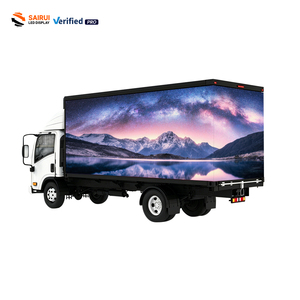
From initial viewing distance analysis, optical pixel pitch calculation, and thermal load modeling through to structural CAD engineering, custom export crating, and site commissioning guidance—we take complete responsibility for project success. Whether outfitting mobile roadshow vehicles like our Battery LED Billboard Truck or complex retail installations using 2mm Flexible Indoor Modules, our integrated export model removes project friction, guarantees supply chain transparency, and protects investor capital.
Clear, unvarnished technical answers to the most common queries raised by AV consultants, system integrators, and procurement directors evaluating Chinese video processing hardware.